
Firecrawl vs. Contextractor: full-service platform or focused extraction?
Firecrawl markets itself as "the web data API for AI" -- a single API that crawls websites, renders JavaScript, extracts content, and outputs LLM-ready markdown or structured JSON1. It's backed by Y Combinator (S22 batch), raised a $14.5M Series A, and has nearly 99K GitHub stars as of March 20262. The pitch is straightforward: one API key, one billing system, every step from URL to clean text handled for you.
Contextractor takes the opposite approach. It doesn't crawl. It doesn't render JavaScript. It takes HTML you already have and extracts the main content using Trafilatura, the top-performing open-source extraction library across independent benchmarks3. That's it.
These aren't really competitors in the traditional sense -- they solve overlapping but different problems. The question isn't which one is "better." It's whether you need a full-service platform or a focused tool that you compose with other pieces.
What Firecrawl bundles (and why that's appealing)
If you've ever built a scraping pipeline from scratch, you know the pain. You need a crawler to discover URLs, a headless browser to render SPAs, proxy rotation to avoid blocks, and an extractor to pull content from rendered HTML. Each piece has its own dependencies, failure modes, and configuration.
Firecrawl wraps all of that into one REST API. Give it a URL, get back markdown. Give it a domain, get back every page as structured data. The /scrape endpoint handles single pages; /crawl discovers and processes entire sites; /map returns URL inventories without fetching content; /search does web search with optional content scraping1.
The Fire-engine component -- closed-source, cloud-only -- handles the hard parts of anti-bot bypassing. It manages headless browser sessions, proxy rotation, and JavaScript rendering internally. You don't think about Playwright configurations or residential proxy pools. That's genuinely valuable when you're dealing with sites that block datacenter IPs or require cookie consent interaction.
For teams that want one vendor and one bill, it's a clean solution. I get the appeal.
Where extraction quality actually matters
Here's the thing about bundling: you're stuck with whatever extraction algorithm the bundle includes. Firecrawl uses its own proprietary extraction pipeline, and there's not much public information about how it works under the hood. No published benchmarks comparing it to established extractors like Trafilatura, Readability, or newspaper4k.
Contextractor uses Trafilatura -- which has been independently evaluated in peer-reviewed research. The SIGIR 2023 study by Bevendorff et al. tested 14 extraction tools across eight datasets and found heuristic extractors "perform the best and are most robust across the board"3. Trafilatura achieved the best overall mean F1 score (0.883) in that evaluation. A 2024 Sandia National Laboratories report confirmed similar results4.
Does that mean Contextractor's extraction is objectively better than Firecrawl's? I can't say -- Firecrawl's extraction hasn't been tested in comparable independent benchmarks. But I can say that Trafilatura's extraction quality is documented, reproducible, and publicly verified. That matters if you're building a pipeline where content quality directly affects downstream results.
Trafilatura's fallback chain is worth mentioning here. It runs its own heuristic pipeline first, falls back to readability-lxml, then to jusText, and picks the best result. Three algorithms competing for the cleanest output. The multi-algorithm approach is a big part of why it tops benchmarks.
The credit system (read the fine print)
Firecrawl's pricing looks simple at first glance. As of March 20265:
| Plan | Monthly cost | Credits/month | Concurrent requests |
|---|---|---|---|
| Free | $0 | 500 (lifetime, not monthly) | 2 |
| Hobby | $16 | 3,000 | 5 |
| Standard | $83 | 100,000 | 50 |
| Growth | $333 | 500,000 | 100 |
| Scale | $599 | 1,000,000 | 150 |
The "pages per month" number on the pricing page assumes 1 credit per page. That's true for basic scraping -- hit a URL, get markdown back. But the moment you use any advanced feature, credits multiply:
- Basic scrape/crawl: 1 credit per page
- AI extraction (structured JSON via LLM): +4 credits per page (so 5 total)
- Enhanced mode (anti-bot for difficult sites): +4 credits per page
- Both combined: 9 credits per page6
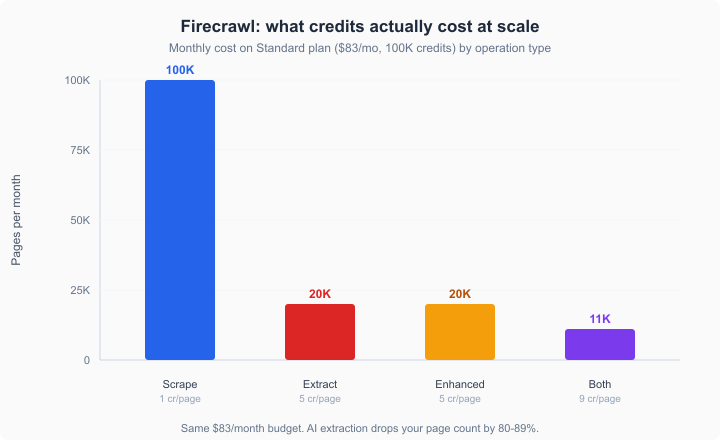 Bar chart showing how AI extraction reduces effective page count on the same budget
That Standard plan at $83/month gets you 100,000 basic scrapes. But if you're using AI extraction -- which is, after all, what most people choosing Firecrawl for AI pipelines would want -- it's actually 20,000 pages. Need Enhanced mode too? 11,111 pages. The per-page cost jumps from $0.00083 to $0.0075.
Plan credits don't roll over month to month either. Extra credits cost $9 per 1,000 on Hobby, roughly $1.34 per 1,000 on Standard6.
The free tier is 500 credits total -- lifetime, not monthly. Enough to test the API, not enough to build anything with.
Output formats
Firecrawl outputs markdown (its primary format), HTML, JSON, and screenshots. The markdown output is designed for LLM consumption, and it's decent for that purpose.
Contextractor outputs plain text, Markdown, HTML, JSON with metadata, XML, and XML-TEI conforming to the Text Encoding Initiative standard7. That TEI output is what makes Trafilatura popular in academic and corpus linguistics circles -- if you need TEI-XML, Firecrawl simply doesn't offer it.
For most developers building RAG pipelines, both tools produce usable markdown. Contextractor gives you more format options if you need them.
API ergonomics
Firecrawl's API is clean. SDKs for Python, Node.js, Go, and Rust. The request/response cycle is predictable:
curl -X POST https://api.firecrawl.dev/v1/scrape \
  -H "Authorization: Bearer fc-YOUR_API_KEY" \
  -H "Content-Type: application/json" \
  -d '{"url": "https://example.com/article"}'
Contextractor runs on Apify's platform, so the API follows Apify's actor paradigm. You call the actor with input parameters, then retrieve results from a dataset. It's a different mental model -- asynchronous by default, with dataset storage for results. Less "call and get response," more "start job and fetch output." The Apify SDK handles this cleanly, but it's an extra abstraction layer.
If you just want "URL in, markdown out" with minimal setup, Firecrawl's API is more direct. No argument there.
MCP server integrations
Firecrawl has a first-party MCP server that plugs into Claude Desktop, Cursor, Windsurf, and VS Code8. It exposes scrape, crawl, map, search, extract, and batch operations as MCP tools. Your AI coding assistant can scrape a page and work with its content directly in the conversation. The setup is quick -- add a JSON config block with your API key and you're running.
Contextractor doesn't have an MCP server. If you need AI-agent-accessible web extraction in your IDE, Firecrawl wins here outright.
That said, for backend pipelines (not IDE integrations), MCP servers don't matter. You'd call either API programmatically from your own code.
Self-hosting
Both are open source, with caveats.
Firecrawl is AGPL-3.0 licensed2. You can self-host the core engine -- scraping, crawling, basic extraction all work. But Fire-engine is closed source, so the self-hosted version lacks the advanced anti-bot features, enhanced proxies, and browser sandboxing that make the cloud version compelling. There's also a community fork called firecrawl-simple that strips out billing and AI features for a lighter self-hosted deployment9.
Contextractor's engine -- Trafilatura -- is Apache 2.0 licensed (since version 1.8.0), which is about as permissive as it gets10. pip install trafilatura and you have the full extraction library running locally. No features are gated behind a cloud version. What you get from the API is the same algorithm you can run yourself.
The self-hosting story is quite different between the two. Firecrawl self-hosted is a significant infrastructure project (Docker, Redis, multiple services). Trafilatura is a Python package you can import in three lines.
When bundling helps
I'd choose Firecrawl if:
- I need to crawl entire domains and don't want to build crawl infrastructure
- The target sites require JavaScript rendering and anti-bot measures
- I want one API key for the whole pipeline from URL discovery to clean content
- I'm building an AI agent that needs MCP-based web access in Cursor or Claude Desktop
- I'm okay with the credit consumption at my expected scale
The all-in-one approach reduces integration complexity. For a team that doesn't have scraping expertise and just wants web data flowing into their LLM pipeline, paying Firecrawl to handle the messy parts is reasonable.
When focused tools win
I'd choose Contextractor if:
- I already have HTML (from my own crawlers, from a CDN, from any source)
- Extraction quality is the priority, and I want a peer-reviewed, benchmarked algorithm
- I need TEI-XML or specific output formats beyond markdown
- I want to self-host the extraction engine without infrastructure overhead
- Cost matters at scale and I don't want credit multipliers eating my budget
The Unix philosophy applies here: do one thing well. If you already have Playwright handling rendering and a crawler discovering URLs, adding Contextractor as the extraction step is cleaner than replacing your whole pipeline with Firecrawl.
For a pipeline that processes 100K pages monthly, running Trafilatura on your own infrastructure costs effectively nothing beyond compute time. Doing the same through Firecrawl's API with AI extraction would require the Growth plan at $333/month -- and even then you'd only get 100K pages at basic scrape rates, or 20K with extraction.
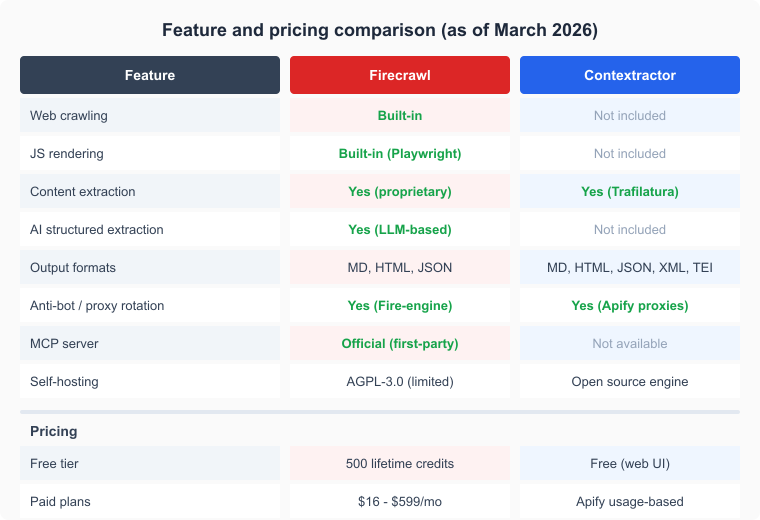 Side-by-side comparison of Firecrawl and Contextractor features and pricing
The honest take
Firecrawl is a well-funded, well-executed product that solves a real pain point. If I were prototyping an AI tool next week and needed web data fast, I'd probably reach for it first. The all-in-one API is hard to beat for speed of integration.
But Firecrawl's value proposition weakens as your scale increases and your needs become more specific. The credit system that looks cheap at $83/month can become expensive quickly once you start using the AI features that justify choosing it over simpler alternatives. And the extraction quality question remains open -- there's no published independent evaluation of Firecrawl's extractor, while Trafilatura's performance is well-documented across multiple academic benchmarks.
Contextractor doesn't try to be everything. It does content extraction and it does it with the best-benchmarked open-source engine available. That's a narrower pitch, but for the use cases where extraction quality matters more than one-API convenience, it's the stronger choice.
Citations
-
Firecrawl: Documentation. Retrieved March 27, 2026 ↩ ↩2
-
Firecrawl: GitHub repository. Retrieved March 27, 2026 ↩ ↩2
-
Janek Bevendorff, Sanket Gupta, Johannes Kiesel, Benno Stein: An Empirical Comparison of Web Content Extraction Algorithms. Proceedings of SIGIR 2023 ↩ ↩2
-
Sandia National Laboratories: An Evaluation of Main Content Extraction Libraries. SAND2024-10208, August 2024 ↩
-
Firecrawl: Billing documentation. Retrieved March 27, 2026 ↩ ↩2
-
Trafilatura: Documentation. Retrieved March 27, 2026 ↩
-
Firecrawl: MCP Server. Retrieved March 27, 2026 ↩
-
Devflowinc: firecrawl-simple. Retrieved March 27, 2026 ↩
-
Trafilatura: PyPI package page. Retrieved March 27, 2026 ↩
Updated: March 27, 2026